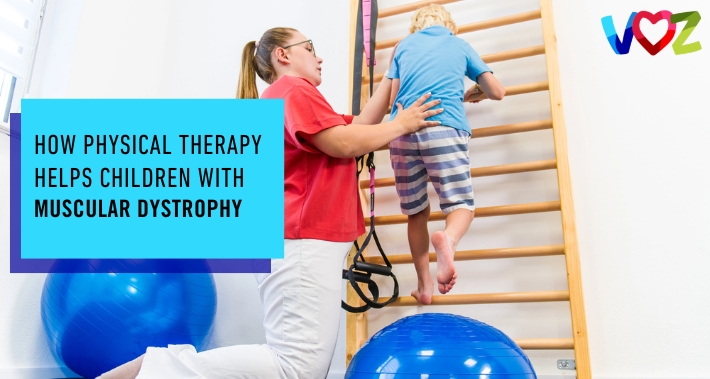
A muscular dystrophy diagnosis can bring a lot of questions for parents.
You may wonder how the condition will affect your child’s movement, independence, daily activities, and overall quality of life.
You may also be wondering what types of support can help your child now and as they grow.
Muscular dystrophy affects each child differently, but it often impacts strength, balance, endurance, mobility, and participation in everyday activities.
These changes can influence how your child plays, learns, moves through their environment, and interacts with the world around them.
While there is currently no cure for muscular dystrophy, a variety of therapies and supports can help children maintain function, build confidence, and stay active.
Pediatric physical therapy is one important part of that support, helping children develop movement strategies that promote safety, comfort, and participation in daily life.
In this article, we’ll take a closer look at muscular dystrophy, the different types that can affect children, the challenges it may create, and how pediatric physical therapy can help support your child’s development and well-being.
What Is Muscular Dystrophy?
Muscular dystrophy is an umbrella term for a group of genetic conditions that cause muscles to weaken over time.
There are many different types of muscular dystrophy, and each one can affect the body in different ways.
These conditions happen because of changes in genes that help the body make proteins needed for healthy muscle function.
When those proteins are missing or do not work properly, muscle fibers can become damaged and weaker over time.
Right now, there is no known cure for muscular dystrophy.
However, healthcare providers can help children manage their symptoms and stay as healthy as possible.
Treatments like pediatric physical therapy, occupational therapy, and speech therapy can help people with this condition live better lives.
We’ll look at some of the more common types below.
Duchenne Muscular Dystrophy (DMD)
Duchenne muscular dystrophy is one of the most common types of muscular dystrophy in children.
It mostly affects boys and often starts in early childhood.
Duchenne muscular dystrophy is caused by changes in the DMD gene, which affects the body’s ability to make dystrophin, a protein that helps protect muscle fibers.
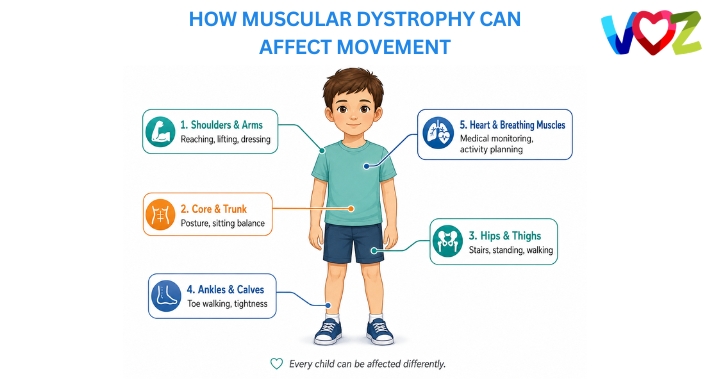
DMD often affects the muscles in your child’s hips, legs, shoulders, and trunk.
It can also affect their heart and breathing muscles over time.
Early signs can include changes in your child’s movement.
Your child may:
- Fall often
- Walk on their toes
- Have large calf muscles
- Have trouble running
- Have difficulty jumping
- Struggle with stairs
- Use their hands to push up from the floor
That last movement can happen when your child’s hips, thighs, and core need more support.
In physical therapy, we focus on safe movement.
We help your child use their strength in ways that support daily life.
We may also help your child work on flexibility, balance, posture, and mobility.
We also help you learn how to support your child at home.
Becker Muscular Dystrophy (BMD)
Becker muscular dystrophy is related to Duchenne muscular dystrophy because both are linked to changes in the same gene.
However, Becker muscular dystrophy usually progresses more slowly and is often less severe than Duchenne muscular dystrophy.
Your child may show signs later in childhood.
Some children show signs during the teen years or as young adults.
BMD often affects the muscles around your child’s hips, thighs, pelvis, shoulders, and upper arms.
These muscles help your child move, climb, stand, reach, and play.
Your child may have trouble with daily movements such as:
- Climbing stairs
- Running
- Standing up from a chair
- Getting up from the floor
- Keeping up during play or sports
Some children with BMD tire more easily during active play.
Some children need walking support later.
Every child’s needs can look different.
Physical therapy can help your child stay active in a safer way.
Therapy may focus on strength, balance, flexibility, and energy use.
Your physical therapist can also help you understand which activities may support your child without placing too much strain on their muscles.
Myotonic Muscular Dystrophy
Myotonic muscular dystrophy can affect children and adults.
This type can affect muscle strength.
It can also affect how muscles relax after they tighten.
For example, your child may grip something and then have trouble letting go.
This can feel frustrating for your child.
Myotonic muscular dystrophy can affect different parts of your child’s body.
It may affect their:
- Hands
- Face
- Neck
- Legs
- Breathing muscles
- Heart
- Digestive system
Your child may also have changes in energy, learning, or daily attention.
This is why your child may need support from several providers.
Your child’s needs may also change over time.
Physical therapy can help your child with movement, posture, balance, and daily activities.
We may work on safe strengthening.
We may also use gentle stretching and movement games.
We choose activities that match your child’s ability and energy.
We also help your child build confidence with the movements they use most.
Limb-Girdle Muscular Dystrophy
Limb-girdle muscular dystrophy affects the muscles around your child’s hips and shoulders.
These muscles help your child stand, walk, climb, reach, and lift their arms.
When these muscles need more support, daily movement can feel harder.
Your child may have trouble with:
- Getting up from the floor
- Standing from a chair
- Walking longer distances
- Climbing stairs
- Lifting their arms over their head
- Carrying items
Some children avoid active play because it feels hard.
Some children also need more breaks during the day.
This can affect school, play, and family routines.
Physical therapy can help your child work on safe movement patterns.
We may support your child’s hip strength, shoulder control, trunk strength, balance, and mobility.
We may also suggest ways to make daily routines easier.
This can include safer ways to get out of a chair, move through the home, or join school activities.
Congenital Muscular Dystrophy
Congenital muscular dystrophy can appear at birth or in early childhood.
Some babies with this type have low muscle tone.
Your baby may feel floppy when you hold them.
Your child may also reach motor milestones later than expected.
These milestones can include:
- Rolling
- Sitting
- Crawling
- Standing
- Walking
Congenital muscular dystrophy can also affect joint movement, breathing, feeding, and vision.
Physical therapy can support early movement skills.
We may help your child with tummy time, rolling, sitting, crawling, standing, and walking.
We may also show you simple ways to support your child during play.
These small daily moments can help your child practice movement in a calm and familiar way.
Facioscapulohumeral Muscular Dystrophy
Facioscapulohumeral muscular dystrophy can affect the face, shoulder blades, and upper arms.
It can also affect the hips, core, and lower legs.
Your child may have more weakness on one side of the body.
This can affect balance, posture, and coordination.
Common signs can include:
- Difficulty lifting the arms
- Shoulder weakness
- Changes in posture
- Changes in walking
- Tiredness during arm or shoulder tasks
- Balance challenges
Physical therapy can help your child move with better support.
We may work on posture, shoulder control, trunk strength, walking, and balance.
We can also help your child learn ways to move without using extra strain.
Others
There are many other types of muscular dystrophy.
Each type can affect your child differently.
Some types change slowly.
Other types need more support earlier in life.
Your child’s diagnosis matters, but your child’s daily life matters too.
We look at what your child can do now, what feels hard, and what kinds of support may help them participate more comfortably in everyday routines.
This helps us create a care plan that feels useful, clear, and personal.
What Causes Muscular Dystrophy?
Muscular dystrophy happens because of changes in your child’s genes.
Genes give your child’s body instructions.
Some genes help the body make proteins that keep muscles strong and healthy.
When a genetic change affects these proteins, the muscles may not function as they should.
Over time, your child’s muscles may become weaker.
Some children inherit muscular dystrophy from a parent.
Others have a new gene change.
This can happen even when no one else in the family has muscular dystrophy.
That can feel confusing.
Physical therapy doesn’t change your child’s genes.
But it can help your child use their body in safer and more supported ways.
It can also help your child build useful movement skills for daily life.
This is one reason why early intervention can help.
The earlier we understand your child’s movement needs, the sooner we can build a plan that supports your child and your family.
What Are The Challenges Of Muscular Dystrophy For Children?
Muscular dystrophy can affect more than your child’s muscles.
It can affect how your child plays, learns, rests, and joins family life.
It can also affect how your child feels about movement.
Your child may want to keep up with other children.
But their body may tire faster.
This can feel frustrating for your child.
It can also feel hard for you as a parent.
Common movement challenges can include:
- Muscle weakness
- Muscle tightness
- Balance problems
- Posture changes
- Walking changes
- Low energy
- More frequent falls
- Trouble with stairs
Muscle weakness can make daily movement harder.
Your child may have trouble walking, climbing stairs, jumping, or standing up from the floor.
They may also avoid games that require fast movement.
Muscle tightness can also affect your child’s comfort.
When muscles get weaker, your child may move less.
When your child moves less, their muscles and joints may get tight.
Tight muscles can make walking, standing, sitting, and dressing harder.
Balance can become harder, too.
Balance helps your child stand, walk, turn, climb, and play.
If your child’s muscles don’t support their body well, balance may feel less steady.
This can make your child feel less confident during movement.
Some children have posture changes.
Your child may lean, arch, or sit in a way that gives them more support.
Over time, posture changes can affect comfort and movement.
Some children may develop scoliosis, condition where the spine curves more than expected.
This can affect sitting, standing, walking, breathing comfort, and daily care.
Your child may need medical monitoring, bracing, or other support.
Some children have breathing challenges.
That’s because breathing uses muscles, too.
When muscular dystrophy affects those muscles, your child may need support from their medical team.
Your child may also need help with posture, positioning, and safe activity.
Some types of muscular dystrophy can affect the heart.
If that’s the case, your child’s doctor may monitor heart health over time.
Your physical therapist can help your child plan movement in a way that respects their medical needs.
Some children also need support with other areas.
These can include:
- Feeding and swallowing
- Speech clarity
- Voice
- Learning
- Emotional support
- School routines
In particular, some types of muscular dystrophy can affect the muscles used for speech, voice, breathing, feeding, and swallowing.
This may lead to challenges such as dysarthria, dysphonia, voice changes, or pediatric dysphagia.
This is why a team approach matters.
Your child may benefit from physical therapy, occupational therapy, speech therapy, and support from other healthcare providers.
Pediatric physical therapy for muscular dystrophy supports your child’s movement needs as part of that larger care plan.
How Physical Therapy Can Help Children With Muscular Dystrophy
Pediatric physical therapy for muscular dystrophy starts with an assessment.
During this visit, your physical therapist will take a full medical history of your child.
From there, they’ll look at how your child moves.
In particular, they may observe your child’s:
- Sitting
- Standing
- Walking
- Balance
- Ability to use stairs
- Posture
- Strength
- Flexibility
- Transitions between positions
Transitions are movements from one position to another.
This can include moving from the floor to standing.
It can also include getting in and out of a chair.
We also ask about your child’s daily life.
We want to know what feels hard at home.
We want to understand what feels difficult at school.
We also want to know what your child enjoys.
Your child is more than a diagnosis.
Your child has interests, strengths, routines, and goals.
After the assessment, we build a plan designed around your child.
Goals may include things like:
- Building gross motor skills
- Improving strength
- Improving balance
- Improving mobility
- Supporting posture
- Improving flexibility
- Saving energy during daily tasks
- Moving with more confidence
Let’s take a closer look at some of the techniques your child may benefit from.
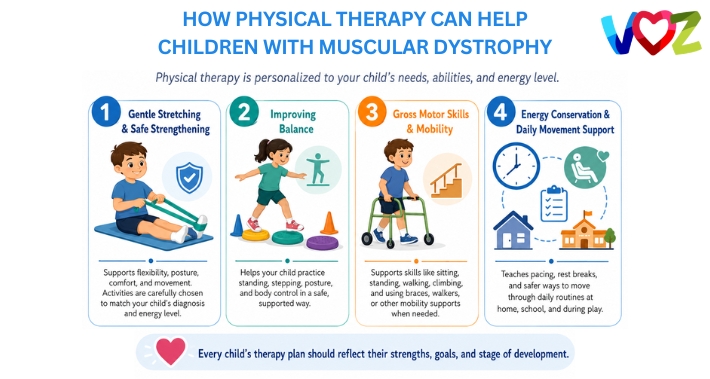
1. Gentle Stretching And Safe Strengthening
Stretching can help your child keep their muscles and joints as flexible as possible.
This may support posture, comfort, and movement.
We may show you stretches for your child’s legs, hips, ankles, trunk, arms, or shoulders.
We keep these stretches gentle.
We also teach you how to do them safely at home.
We may also use carefully selected strengthening activities when appropriate.
Strength work should always match your child’s diagnosis, stage of development, energy level, and medical needs.
Because too much strain can increase fatigue, we choose activities carefully and adjust them as your child’s needs change.
2. Improving Balance
It’s common for children with muscular dystrophy to have difficulty with balance.
Physical therapy can help your child practice balance in a safe, supported way.
Balance activities may include:
- Standing games
- Stepping activities
- Safe obstacle courses
- Weight shifts
- Posture practice
- Body control activities
3. Gross Motor Skills Development
Gross motor skills are big body movements.
They include rolling, sitting, crawling, standing, walking, running, jumping, and climbing.
In particular, kids with muscular dystrophy may benefit from mobility support.
For some children, this means walking with better control.
For others, it means learning how to use support tools.
Support tools may include:
- Braces
- Walkers
- Wheelchairs
- Positioning equipment
- Other mobility supports
These tools can help your child join more parts of daily life.
4. Energy Conservation And Daily Movement Support
Children with muscular dystrophy may tire more quickly during everyday activities.
Physical therapy can help your child learn ways to use their energy more efficiently throughout the day.
This may include pacing strategies, rest breaks, safer ways to move between activities, and recommendations for supportive equipment when needed.
These strategies can help your child participate more comfortably at home, at school, and during play.
Book Your Appointment With The Voz Institute Today
A muscular dystrophy diagnosis can bring many uncertainties, but your child’s diagnosis does not define their potential.
With the right support, children with muscular dystrophy can continue to build confidence, support their mobility, and participate in the activities that matter most to them
Pediatric physical therapy helps children develop safe movement strategies, maintain mobility, improve balance, and support independence throughout different stages of development.
Many children also benefit from a multidisciplinary approach that may include pediatric occupational therapy and pediatric speech therapy to address daily living skills, communication, feeding, and other challenges.
At The Voz Institute, our team of therapists works closely with families to create personalized therapy plans that reflect each child’s unique strengths, goals, and needs.
Book your appointment with The Voz Institute today and take the next step toward helping your child move, grow, and thrive with confidence.
1100 H St NW Ste 940,
Washington, DC 20005
(202) 734-4884
- https://g.page/vozspeechtherapy
The Voz Institute is a bilingual speech therapy and pediatric occupational therapy clinic in Washington, DC that provides individualized services based on the specific needs of you or your child. Therapy sessions are provided in English or Spanish, depending on your or your child’s native language.
1100 H St NW Ste 940,
Washington, DC 20005
(202) 734-4884
- https://g.page/vozspeechtherapy
El Instituto Voz es una clínica bilingüe de terapia del habla y terapia ocupacional pediátrica en Washington, DC, que ofrece servicios individualizados según las necesidades específicas tuyas o de tu hijo. Las sesiones de terapia se ofrecen en inglés o español, dependiendo del idioma nativo tuyo o de tu hijo.