Does your child seem to frequently have emotional outbursts? Do they seem to have trouble with their fine motor skills? Are everyday tasks, like self care activities, difficult for them?
For all these, and more, pediatric occupational therapy can help.
We know that every child is unique. Some children find it easy to play, write, get dressed, or focus. Others may struggle with these everyday tasks.
That’s where occupational therapy can help your child.
Our licensed therapists support kids who are facing challenges in their daily lives.
We offer personalized therapy plans that are fun, gentle, and effective. Every session is built around your child’s needs and strengths.
If you live in the Washington, DC area and you’re looking for expert pediatric occupational therapy services, The Voz Institute can help.
What Is Occupational Therapy?
Occupational therapy, often called OT, helps people do daily activities (or “occupations”) that are important to them.
For children, these activities include playing, learning, moving, using their hands, and taking care of themselves.
When a child has difficulty with these tasks, OT can help them build the skills, strength, and confidence they need.
Pediatric occupational therapists are trained to understand how a child’s brain, body, and emotions work together.
In particular, occupational therapists can help with:
- Fine motor skills delays
- Sensory processing differences
- Self care activities
- Navigating life with disabilities
- Helping autistic children navigate life
- Improving handwriting
- Social participation
- Hand-eye coordination
- Attention and emotional regulation
- And more
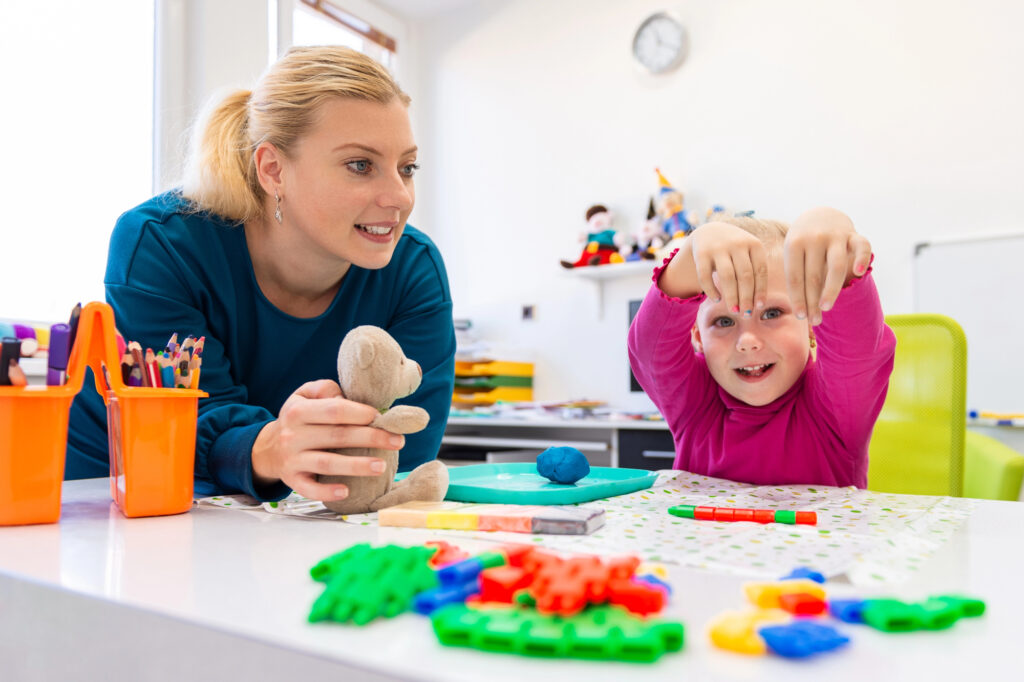
Occupational therapists use games, stories, toys, and movement to help kids learn.
As a parent, occupational therapy sessions may look like playtime with your child.
But there’s more to it than that. Every part is carefully planned to teach important life skills.
At The Voz Institute, our goal is to support your child and your family so life feels easier and more joyful.
Occupational Therapy For Sensory Processing Disorder
For some children, sensory inputs can feel much bigger than average. For others, they can be much smaller.
This is called sensory processing disorder.
Sensory processing disorder happens when the brain has trouble organizing information from the senses.
For example, your child might:
- Cover their ears at loud noises
- Get upset in bright lights or crowded places
- Refuse to wear clothes made of certain materials
- Refuse to eat foods with certain textures
- Enjoy spinning, crashing, or jumping
- Seem clumsy or easily distracted
When some kids are exposed to bigger sensory inputs, it can be distressing.
On the other hand, kids with reduced sensory awareness might not realize when something is painful until they’re more seriously injured.
At The Voz Institute, we design special sensory-friendly plans to help your child feel calm, focused, and safe in their body.
When your child’s body feels more balanced, their mind becomes calmer, too.
Occupational therapy for sensory processing disorder can help improve attention, behavior, sleep, and social skills.
But most importantly, it helps children feel more in control.
If your child has sensory processing disorder, it can feel overwhelming for them.
But it doesn’t have to stay that way. We’re here to help.
Occupational Therapy For Emotional Regulation Issues
Big feelings can be hard to manage. That’s true for adults, but it’s even truer for kids.
After all, adults have the benefit of years of learning how our emotions work.
Kids don’t.
If your child has emotional regulation challenges, they may:
- Cry, scream, or shut down often
- Have sudden outbursts or tantrums
- Struggle to calm down once upset
- Avoid talking about their feelings
- Feel overwhelmed or anxious
As a parent, this can feel distressing as well.
But your child is acting this way for a reason, and occupational therapy can help.
Occupational therapy helps children understand and express their emotions in healthy ways.
We teach kids how to recognize what they feel in their bodies, use calming tools, and ask for help when needed.
We also work closely with parents, caregivers, and teachers to create routines and strategies that support emotional growth at home and school.
With occupational therapy, children learn that feelings are okay.
What’s more, they learn that they have the power to manage them.
Occupational Therapy For Executive Dysfunction
Executive functioning helps us plan, organize, remember, and finish tasks.
But for some, executive functioning can be a significant challenge.
Executive dysfunction refers to deficits in your child’s ability to do these important tasks.
From the outside, this might look like your child is lazy or defiant. But they’re not – they’re doing their best to work through a disability.
If your child has executive dysfunction, they may:
- Have difficulty remembering their homework
- Forget the instructions you give them
- Have difficulty starting tasks
- Get stuck on small details
- Get distracted easily
- Struggle with routines or time
These challenges can affect schoolwork, friendships, and family life. Kids may feel frustrated or fall behind, even if they’re trying hard.
Our therapists use fun, step by step games and activities to build executive functioning skills.
Over time, these tools help kids feel more focused and confident. They learn how to plan ahead, solve problems, and stay on track.
Occupational Therapy For Improving Fine Motor Skills
Fine motor skills are the small movements we use in our hands and fingers.
We use these skills to do all manner of different things in daily life.
For kids, this can include things like:
- Writing and drawing
- Eating with a spoon or fork
- Tying their shoes
- Fastening buttons, zippers, or velcro
- Playing with toys
- And more
If your child avoids these activities or struggles to keep up, they may need help with fine motor skills.
At The Voz Institute, we use play based activities to help build their fine motor skills.
These activities can strengthen your child’s hand and finger muscles, build coordination, and improve control.
Fine motor strength also supports your child’s ability to write clearly and complete tasks at school.
With the right support, your child can feel more independent and successful in all areas of life.
Occupational Therapy For Improving Handwriting
Handwriting is an important part of learning. But it doesn’t come easily to every child.
That said, every child’s handwriting is messy at first. But if they’re starting to fall behind, it can be a sign of a deeper issue.
Signs your child may need handwriting support include:
- Poor letter formation
- Difficulty writing in a straight line
- Complaining of pain in their hands
- Uneven word sizes or spacing
- Frequently reversing letters
- Frequently missing words
Your pediatric occupational therapist will assess your child’s posture, pencil grip, fine motor skills, and visual processing.
Then we create a personalized plan that makes writing easier and more fun.
Clear handwriting helps children feel proud and confident in school.
With consistent practice, writing becomes less of a struggle, and more of a skill they enjoy.
Occupational Therapy For Activities of Daily Living
What are activities of daily living? These are the basic skills children need for independence.
They include things like:
- Brushing their teeth
- Washing their face
- Getting dressed
- Brushing their hair
- Going to the washroom
- Washing their hands
- Eating and drinking
- And many others
If your child avoids these tasks or depends on adults more than other children their age, OT can help.
We break these routines down into simple steps using pictures, songs, and practice.
Our goal is to help your child feel confident doing things on their own. That way, they build both independence and self-esteem.
We also guide parents on how to support progress at home, using routines that feel safe, gentle, and encouraging.
Book Your Appointment With The Voz Institute Today
Every child learns and grows in their own way.
At The Voz Institute, we meet each child where they are.
From there, we help them get where they need to be.
Our pediatric occupational therapists in Washington, DC bring years of experience, warmth, and creativity to every session.
Whether your child is struggling with focus, handwriting, emotions, or everyday routines, we are here to help.