You’ve likely heard of ADHD before.
It’s a condition that can affect your ability to focus, control your impulses, and more.
However, you may not realize it can also affect the development of speech, language, and communication skills.
Here at The Voz Institute, we offer pediatric speech therapy services for a variety of different diagnoses and conditions.
One of these is ADHD.
But since ADHD isn’t usually associated with speech therapy, we’ll be taking a closer look at it in this article.
What Is ADHD?
ADHD is a form of neurodivergence.
That means it’s a difference in the way the brain develops.
It stands for “attention deficit/hyperactivity disorder”.
Like the name suggests, people with ADHD have difficulty paying attention.
They also tend to have poorer impulse control.
There are three main types, or categories of ADHD:
- Predominantly inattentive
- Predominantly hyperactive-impulsive
- Mixed
Predominantly inattentive ADHD is characterized by difficulty finishing tasks, focusing, and following instructions.
This type is more common in girls.
Hyperactive-impulsive ADHD is characterized by fidgeting, difficulty waiting their turn, and seeming impatience.
Mixed ADHD is a blend of these two, and is the most common type of ADHD.
Aren’t All Kids A Little ADHD?
No.
Children in general tend to have more energy than adults, of course.
This can look like difficulty sitting still and more impulsivity.
However, that’s not the same as ADHD.
How To Tell If Your Child Has ADHD?
We already mentioned the three main categories of ADHD above.
Let’s take a closer look at what you might notice if your child has undiagnosed ADHD.
If your child has inattentive ADHD, they may:
- Have trouble concentrating
- Have difficulty staying focused on tasks
- Appear to not listen when you speak to them
- Have difficulty learning new things
- Have difficulty planning and organizing
- Frequently be late to things
If your child has hyperactive-impulsive ADHD, they may:
- Have trouble sitting still
- Seem to bounce from one activity to the next
- Frequently want to do multiple things at once
- Frequently fidget
- Have difficulty thinking through the consequences of actions
- Have difficulty waiting their turn, especially during games or in conversation
Children with mixed ADHD may display a mix of the above traits.
What Causes ADHD?
Research is still ongoing to discover a direct cause of ADHD.
Today, it is thought to have genetic or neurological origins.
Many children with ADHD often have family members who also have ADHD.
However, we haven’t yet pinpointed a specific gene that causes ADHD.
It’s also been shown that brains with ADHD have reduced grey matter and white matter, but we’re not sure what causes this.
Other potential causes may include:
- Smoking during pregnancy
- Alcohol use during pregnancy
- Extreme stress during pregnancy
- Being born premature or having low birth weight
- Lead exposure during pregnancy
However, children are born with ADHD who don’t have any of the above factors present.
How Does ADHD Affect Speech And Language?
ADHD is not considered a speech or language disorder on its own.
However, it can still affect the way a child’s speech and language develops.
It can affect both their expressive and receptive language development.
Expressive language refers to the more active role in communication – the ideas you express.
From an expressive perspective, children with ADHD may have challenges with:
- Controlling the volume of their voice
- Controlling the rate of their speech
- Organizing their thoughts
- Finding the right words to use
- Telling a coherent story
- Spelling and grammar
The fact that kids with ADHD often have difficulty with spelling and grammar can make it seem like they have dyslexia.
These are two distinct conditions, but they frequently overlap.
In fact, about 30% of dyslexic people also have ADHD.
However, they don’t have a causal relationship, and plenty of people have one but not the other.
From a receptive perspective – the communication you receive from others – children with ADHD may have challenges with:
- Listening to others
- Waiting their turn in conversation
- Following directions
- Understanding non-spoken cues, like body language
How Can Speech Therapy Help With ADHD?
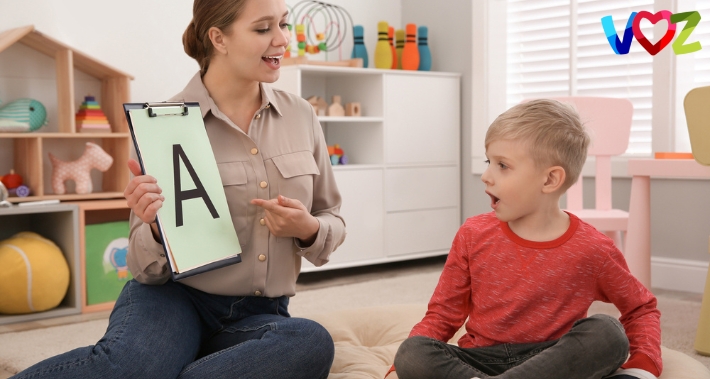
Speech therapy is a great resource to consider if you think your child might have ADHD.
Your pediatric speech therapist will start with a speech therapy screening.
During this time, they’ll check for ADHD, and any other speech or language delays or disorders.
From there, your child’s speech therapist will review their findings with you.
This will help you to better understand your child’s condition.
RELATED: Speech Therapy Coaching For Parents
Then, they’ll put together a treatment plan to help your child with any speech or language differences they have.
The goal is to help your child to better express themselves, and to communicate better with their peers.
Book Your Appointment With The Voz Institute Today
If you suspect your child has ADHD, you might not immediately think of speech therapy.
But a speech therapist can help.
Book your appointment with The Voz Institute today, to find out how.
1100 H St NW Ste 940,
Washington, DC 20005
(202) 734-4884
- https://g.page/vozspeechtherapy
The Voz Institute is a bilingual speech therapy and pediatric occupational therapy clinic in Washington, DC that provides individualized services based on the specific needs of you or your child. Therapy sessions are provided in English or Spanish, depending on your or your child’s native language.
1100 H St NW Ste 940,
Washington, DC 20005
(202) 734-4884
- https://g.page/vozspeechtherapy
El Instituto Voz es una clínica bilingüe de terapia del habla y terapia ocupacional pediátrica en Washington, DC, que ofrece servicios individualizados según las necesidades específicas tuyas o de tu hijo. Las sesiones de terapia se ofrecen en inglés o español, dependiendo del idioma nativo tuyo o de tu hijo.