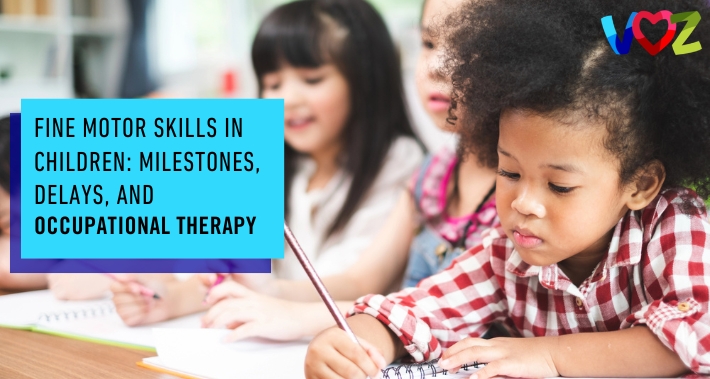
Fine motor skills play a foundational role in your child’s development.
From brushing their teeth and getting dressed to writing, drawing, and participating in classroom activities, these small muscle movements form the building blocks for independence and academic success.
Even larger movements, like throwing a ball, depend on first learning how to grasp and control objects with the hands.
Most children develop these skills naturally over time.
However, if you notice delays in your child’s fine motor skills development, it’s understandable to have questions.
Understanding what fine motor skills are, what typical development looks like, and what might interfere with progress can help you determine whether additional support may be beneficial.
In this article, we’ll take a closer look at fine motor skills, the conditions that can affect their development, and how occupational therapy can support children who need extra help strengthening these important abilities.
What Are Fine Motor Skills?
Your fine motor skills are what allow you to make a wide range of small muscle movements, primarily in your hands and wrists.
You use these skills for an endless number of everyday tasks, as well as school and work duties.
Just about every task that requires the use of your hands will call on your fine motor skills.
Examples include:
- Writing
- Drawing or painting
- Typing
- Brushing your teeth
- Combing your hair
- Getting dressed
- Tying your shoes
- Holding things
- Using a spoon or fork
- And much more
Most people don’t think much about these skills, even while using them.
However, your fine motor skills involve a complex process where your brain sends messages to your muscles to initiate movement.
What Can Affect Fine Motor Skills Development?
Let’s take a closer look at a few different types of conditions that may affect your child’s fine motor skills development.
1. ADHD
Attention deficit hyperactivity disorder (ADHD) is difference in brain development.
In other words, kids with ADHD have brains that work differently than most.
In particular, this difference affects their impulse control and executive function.
Experts classify this disorder into one of three subtypes:
- Predominantly inattentive type
- Predominantly hyperactive-impulse type
- Mixed type
If your child has ADHD, their traits may differ depending on their specific subtype.
For instance, a child with predominantly inattentive ADHD might have differences with:
- Concentration
- Task initiation
- Planning and organizing
- Active listening
- Time management
Conversely, a child with predominantly hyperactive-impulsive ADHD might have differences with:
- Sitting still
- Paying attention
- Turn taking
- Patience
Finally, a child with mixed ADHD will likely show a combination of the two.
Kids with ADHD are also more likely to have differences in their fine motor function, according to a 2019 study by Mokobane Et Al..
In particular, this can affect their handwriting skills.
Researchers have not yet identified a specific cause for ADHD; however, both genetic and neurological factors likely play a role.
RELATED ARTICLE: Why Some Kids Struggle With Handwriting And How Occupational Therapy Helps
2. Dyspraxia (Developmental Coordination Disorder)
Dyspraxia is another form of neurodiversity.
It’s also known as developmental coordination disorder, or DCD.
In this case, it can affect a child’s balance, coordination, and movement skills.
In particular, children with dyspraxia often find the planning and execution of fine motor skill tasks, such as writing, to be a challenge.
Other signs of dyspraxia include:
- Learning and memory differences
- Not understanding social cues
- Differences in time management skills
- Differences in planning and organizational skills
- Challenges with self care tasks, such as dressing, bathing, and eating
- Chronic fatigue
- Delayed milestone achievement in babies, such as crawling, sitting, and walking
- Poor posture
Researchers are still trying to pinpoint the exact cause(s) of dyspraxia.
However, some theories suggest that children with this condition have underdeveloped motor neurons.
3. Learning Disabilities
Learning disabilities is an umbrella term for a wide range of diagnoses that interfere with the brain processes involved in learning.
However, it has nothing to do with intelligence.
Children with learning disabilities often have average or even above average intelligence.
The main difference is in how they learn new information and skills.
Learning disabilities commonly have a genetic component, meaning parents with learning disabilities are more likely to have children with them.
Several different types of learning disabilities may affect your child’s fine motor skills development.
Dysgraphia is a common example.
This can make it difficult for your child to convey their thoughts through writing.
This can affect things like:
- Letter size
- Spacing
- Legibility
- Spelling and grammar
- Writing in a straight line
- Holding different writing utensils
- Punctuation
- Understanding the difference between verbs and pronouns
Writing is a complex process that many of us take for granted as adults.
Occupational and speech therapy can help with dysgraphia and other learning disabilities.
RELATED ARTICLE: What Causes Developmental Delays In Speech And Language
4. Autism
Autism is another type of neurodiversity.
Like everyone, each autistic child is unique.
That means they have different traits.
That’s true with many different diagnoses, but it’s particularly true with autism.
Some autistic children may have just a few traits commonly associated with autism, while others may have a great many of them.
Very few autistic children display every trait associated with autism.
However, these traits may include:
- Repetitive speech patterns
- Repetitive movements or actions
- An extreme focus on their interests
- Lack of interest in anything outside their special interests
- Reluctance to make eye contact
- Expressing their emotions differently
- Differences in social skills
- Speaking with a monotone pitch
- Differences in sensory processing
- Difficulty understanding unspoken communication, like sarcasm or facial expressions
- And others
The early signs of autism are a little different, since they’re in babies.
They may include not gesturing, not making eye contact, not recognizing their own name, and not making facial expressions.
There is no known cure for autism, and there is unlikely to ever be one.
This is just one of the many myths about autism some still believe.
Autism speech therapy may be beneficial for your child, as can occupational therapy.
5. Other Diagnoses
The above are just a few examples.
Other diagnoses that may affect your child’s fine motor skills development include:
- Cerebral palsy
- Down syndrome
- Spina bifida
- Pediatric stroke
- Traumatic brain injury
- Juvenile arthritis
- And others
How Do I Know If My Child Has Fine Motor Skills Delays?
If your child has fine motor skills delays, you’ll likely notice that they aren’t reaching their expected developmental milestones.
Developmental milestones refer to a group of skills that most children achieve by a certain age.
Of course, every child develops at their own pace.
Thus, slight delays in milestone achievement are perfectly natural and nothing to worry about.
However, if you’re noticing that your child is taking significantly longer than expected to reach their milestones, or even not reaching them at all, consider bringing them to The Voz Institute for a pediatric evaluation.
Next, we’ll take a look at some of the different types of fine motor skills milestones that you can watch out for in your child.
At 4 Months Old
By 4 months of age, most children can use their fine motor skills to:
- Hold small objects
- Put their hands in their mouth
- Bring their hands together
- Open and close their fists
- Push up using their arms during tummy time
- Follow objects with their eyes
At 6 Months Old
By 6 months of age, most children can use their fine motor skills to:
- Reach for their toys with both hands
- Bring toys to their mouth
- Use a raking grasp
- Move objects between hands
- Open their fists and relax their hands
- Start to pick up small food items
At 12 Months Old
By 12 months of age, most children can use their fine motor skills to:
- Grab and release objects, such as toys
- Hand over objects to their caregivers
- Bang two objects together
- Turn a few pages of a book at a time
- Place toys into containers
- Point
- Stack 2 blocks
At 18 Months Old
By 18 months of age, most children can use their fine motor skills to:
- Clap hands
- Wave hello and goodbye
- Play with both hands
- Use writing utensils to scribble
- Begin to use eating utensils
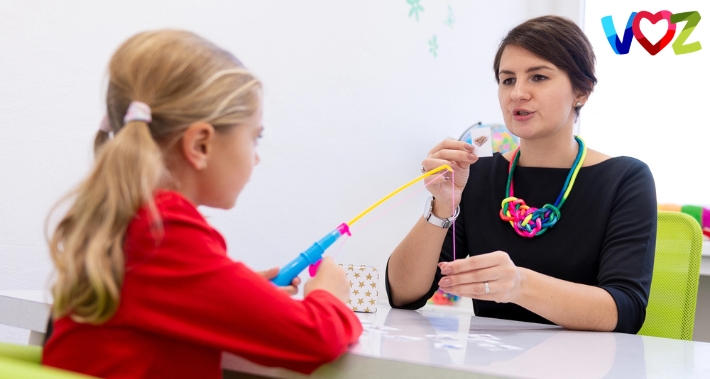
How Can An Occupational Therapist Help With Fine Motor Skills Delays?
At The Voz Institute, our occupational therapists can help children facing fine motor delays in a variety of ways.
At their first appointment, your child’s occupational therapist will conduct a comprehensive evaluation to better understand their specific challenges.
From there, we’ll put together an individualized intervention plan that focuses on your child’s specific needs.
We frequently utilize different forms of play therapy to help children develop their fine motor skills.
For instance, we might encourage your child to play with putty to help strengthen the muscles in their hands and wrists.
We also might incorporate other types of artistic expression, such as finger painting or making things with play putty.
This may seem like just play on the surface, but there’s a lot more to it than that.
These simple tasks can help your child develop their fine motor skills.
The goal is to help your child build their strengths and their self esteem, and address your concerns.
From there, your child will be prepared for whatever fine motor skills tasks the world throws their way.
Book Your Appointment With The Voz Institute Today
Fine motor skills are essential building blocks for your child’s independence, confidence, and academic success.
While every child develops at their own pace, ongoing difficulties with grasping, writing, dressing, or using utensils may signal the need for additional support.
Pediatric occupational therapy can target the underlying motor, coordination, and sensory challenges that impact these everyday tasks.
Through engaging, play-based interventions, children can strengthen their skills while building confidence and self-esteem.
Early support can make a meaningful difference in helping your child feel capable and prepared for school and daily life.
Book your appointment with The Voz Institute today and take the next step in supporting your child’s fine motor development.
1100 H St NW Ste 940,
Washington, DC 20005
(202) 734-4884
- https://g.page/vozspeechtherapy
The Voz Institute is a bilingual speech therapy and pediatric occupational therapy clinic in Washington, DC that provides individualized services based on the specific needs of you or your child. Therapy sessions are provided in English or Spanish, depending on your or your child’s native language.
1100 H St NW Ste 940,
Washington, DC 20005
(202) 734-4884
- https://g.page/vozspeechtherapy
El Instituto Voz es una clínica bilingüe de terapia del habla y terapia ocupacional pediátrica en Washington, DC, que ofrece servicios individualizados según las necesidades específicas tuyas o de tu hijo. Las sesiones de terapia se ofrecen en inglés o español, dependiendo del idioma nativo tuyo o de tu hijo.