Do you have a loved one who’s experienced a stroke or a traumatic brain injury?
If so, they may have aphasia.
Aphasia is often caused by a stroke or traumatic brain injury, making it a neurological disorder.
But it also affects the way you convey and receive information, making it an expressive and/or receptive language disorder as well.
But regardless of how you categorize it, a speech and language therapist can help.
Read on to discover more about aphasia, its impacts on communication and expressive language, and how you can support a loved one with aphasia.
RECAP: What Is Aphasia?
We talked about aphasia before in a previous blog article: What Is Aphasia?
For more details, check it out.
But here’s a brief overview of aphasia.
Aphasia is a language disorder that impacts your ability to understand and express both written and spoken language.
It doesn’t impact intelligence, but it can impact your ability to read and write.
It’s fairly common, especially in stroke survivors.
In fact, according to the National Aphasia Association, more people have aphasia than many other common conditions, including:
- Cerebral palsy
- Multiple sclerosis
- Parkinson’s disease
- Muscular dystrophy
Stroke is the third leading cause of death in the United States, and about a third of stroke survivors will experience aphasia.
However, according to the National Aphasia Association page linked above, nearly 85% of people have never heard of it.
That’s one of the reasons why we write the blog articles we do here at The Voz Institute – awareness is important.
A stroke happens when the brain’s blood supply is cut off.
This can happen due to blocked arteries or a burst blood vessel.
In either case, the brain doesn’t get enough oxygen, and this can result in damage to various brain areas.
When a stroke impacts the language areas of the brain, usually on the left side, aphasia can result.
On top of a stroke or traumatic brain injury, aphasia can also be caused by a brain tumor, infection, or other progressive disease impacting these language areas.
A temporary form of aphasia can also occur as a result of seizures, migraines, or a temporary blockage of blood flow to the brain, known as a temporary ischemic attack (TIA).
Aphasia may have a sudden impact or a gradual, progressive onset of symptoms.
Speech therapy after a stroke will often focus on aphasia treatment.
How Does Aphasia Make Communication Challenging?
Aphasia can impact their communication in a number of ways.
Let’s take a look.
It Can Affect Expressive Language
Expressive aphasia involves trouble expressing yourself through writing or reading.
Individuals experiencing expressive language difficulties may:
- Not be able to think of the words they want to say
- Use incorrect words when speaking
- Substitute one sound for another in a word
- Make word-like sounds that aren’t actual words
- Repeat common words or phrases
- Have difficulty writing sentences
- Have difficulty spelling
People with aphasia often have an easier time with single words or two word sentences.
These difficulties can further be broken down into non-fluent and fluent expressive aphasia.
Non-fluent aphasia involves having trouble with speaking overall, including with finding the right words or forming sentences.
On the other hand, in fluent expressive aphasia, a person may be able to put sentences together, but the expression of this sentence doesn’t come out right or make sense.
It Can Affect Receptive Language
Receptive language is how you understand the ideas others have expressed to you.
That includes being able to understand both spoken and written ideas.
Individuals experiencing receptive aphasia may have trouble:
- Recognizing an object by name
- Following instructions
- Understanding what someone else is trying to communicate to them
- Reading signs, books, or other written material
- Understanding sarcasm, puns, jokes, or any other spoken communication that is not direct
- Understanding the meaning of certain words
There are situations where these difficulties with understanding may show up more intensely.
This includes when others speak quickly, form complex sentences, or are in a busy area with lots of distractions.
Tips for Communicating With An Adult Who Has Aphasia
Individuals with aphasia may experience a whole host of emotions associated with the condition.
It can be a frustrating and frightening experience.
For you, their loved one, it can be difficult to know what to do or say.
However, there are ways to make it easier.
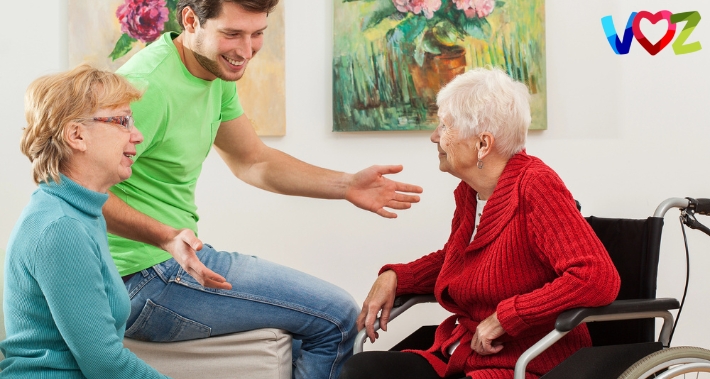
You can support individuals with aphasia by using these tips when communicating:
- Limit visual distractions and background noises
- Move to a quiet room
- Continue to talk to the person as an adult and avoid childlike language
- Don’t pretend to understand things you don’t understand
- Maintain eye contact
- Get the person’s attention before speaking
- Don’t shout if the person cannot understand you, and allow the person time to understand you
- Use visual cues, such as facial gestures
- Keep them involved in the conversation so they feel included
- Don’t speak about them as if they aren’t there
- Speak slowly
- Ask questions with “yes” or “no answers or offer simple options rather than open ended questions
- Don’t finish sentences for them
- Break down any instructions into simpler steps
You can also encourage them to use alternative modes of communication.
Your speech therapist can help you choose an AAC method.
As you communicate more and more with your loved one with aphasia, continue to check in with them and see where they are and if they understand you.
At each step of the way, provide them with encouragement.
Make sure not to push them too much to understand you, though, as it can increase frustration levels.
If they make mistakes while communicating with you, allow them to.
After all, everyone makes mistakes.
It may take time for them to improve their skills.
But if they are feeling more confident and up for it, you can take them outside more to provide practice for their communication skills.
How Can Speech Therapy Help?
Recovery after aphasia depends on the extent of the brain damage.
In milder cases, your loved one may see full recovery.
However, more serious cases may not ever regain their full communication abilities.
Regardless, however, speech therapy can help.
Speech therapy will involve a partnership between a speech therapist, your loved one, and their primary caretakers.
You’ll work together to discuss individual needs and goals, leading to participation in the things that matter to your loved one.
The goal is to help your loved one communicate with others.
This includes exploring AAC options, as well as speech and language exercises.
Your speech therapist will also help you understand how to support your loved one throughout their journey.
Book Your Appointment With The Voz Institute Today
Has your loved one experienced a stroke or traumatic brain injury?
Are they not able to communicate as well as they used to?
Here at The Voz Institute, we can help.
Book your appointment with The Voz Institute today, to get started.
1100 H St NW Ste 940,
Washington, DC 20005
(202) 734-4884
- https://g.page/vozspeechtherapy
The Voz Institute is a bilingual speech therapy and pediatric occupational therapy clinic in Washington, DC that provides individualized services based on the specific needs of you or your child. Therapy sessions are provided in English or Spanish, depending on your or your child’s native language.
1100 H St NW Ste 940,
Washington, DC 20005
(202) 734-4884
- https://g.page/vozspeechtherapy
El Instituto Voz es una clínica bilingüe de terapia del habla y terapia ocupacional pediátrica en Washington, DC, que ofrece servicios individualizados según las necesidades específicas tuyas o de tu hijo. Las sesiones de terapia se ofrecen en inglés o español, dependiendo del idioma nativo tuyo o de tu hijo.