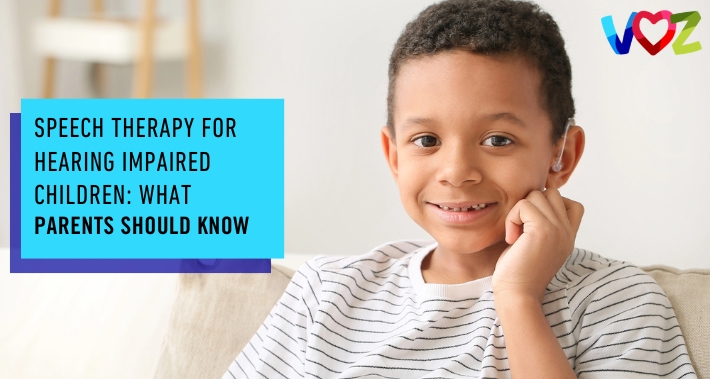
As the parent of a child with hearing impairment, there are several important decisions to consider when it comes to your child’s speech and language development.
You may find yourself asking questions like:
Which amplification option is best?
Should we learn sign language?
When should we begin speech therapy?
If your child develops hearing loss later in childhood, they may be able to take part in these decisions.
But for infants and toddlers, these choices often fall entirely on you as a parent or caregiver.
Understandably, this can feel overwhelming.
The good news is that there are multiple effective approaches to communication and development, and no single path is right for every child.
With the right information and early support, you can make decisions that align with your child’s needs and your family’s values.
In this article, we’ll explore what hearing impairment means, how it can affect speech and language development, and the different ways pediatric speech therapy can support your child in their communication journey.
What Does It Mean To Be Hearing Impaired?
Loosely speaking, hearing impairment refers to any condition that causes challenges with your child’s hearing.
However, not everyone experiences hearing impairment the same way.
Some people with hearing impairment experience only mild hearing loss.
They may only have trouble hearing a conversation in a noisy environment, or have difficulty with certain frequencies.
Others only have hearing loss in one ear.
Meanwhile, others have more profound, or even complete hearing loss.
Some types of hearing impairment are temporary whereas others are permanent.
For instance, some people experience temporary hearing loss during a severe ear infection whereas others develop permanent hearing loss.
Hearing impairment can occur at any age.

What Causes Hearing Impairment In Kids?
Many different factors can contribute to hearing impairment in your child.
Genetics play a significant role.
According to the University of Michigan Health, over 50% of children with hearing impairment have genetic factors for their condition.
So, you’re more likely to have a hearing impaired child if you have a family history of hearing loss.
Other factors for hearing impairments include both sudden and progressive causes.
For instance, sudden hearing impairment may develop following exposure to a very loud noise.
Conversely, progressive hearing loss worsens over time most commonly due to certain diseases, such as Ménière’s disease.
Finally, many children experience hearing impairment due to chronic ear infections.
Your middle ear plays an essential role in your ability to hear.
It’s the pipeline that passes different sounds to your brain.
Kids who experience chronic ear infections often have fluid in their middle ear, even when they’re not fighting off an infection.
Subsequently, this fluid stops sounds from reaching your brain and can result in significant hearing challenges.
RELATED ARTICLE: Can Constant Ear Infections Cause Speech and Language Delays in Children?
How Does Hearing Impairment Affect Speech And Language Development?
We’ve actually already answered this question in much greater depth in an article.
For more information, see the following article – How Does Hearing Impairment Affect Development For Children?
But for today’s purposes, here’s a briefer recap.
Hearing impairment can affect your child’s speech and language development in multiple ways.
The types of speech and language challenges your child might face largely depends on the severity of their hearing loss.
For instance, children with mild hearing loss sometimes have trouble hearing certain sounds, such as ‘s’, ‘t’, ‘sh’, ‘f’, and ‘th’.
Since these sounds are common within the English language, even mild hearing impairment can significantly impact your child’s speech development.
Children with mild hearing impairment often have trouble understanding what others are saying, as well as producing speech that others can easily understand.
Children with severe or profound hearing impairment face additional challenges.
Some common speech and language challenges amongst hearing impaired children include:
- Difficulty learning new words
- Difficulty using and understanding proper sentence structure
- Challenges producing speech that’s clear and intelligible
- Difficulty developing social skills
RELATED ARTICLE: How to Recognize Speech or Language Developmental Delays in Children
How Can Speech Therapy Help Hearing Impaired Kids?
At The Voz Institute, our speech therapists have plenty of resources that can help hearing impaired children thrive at home, in school, as well as within their social lives.
The type of techniques your child’s speech therapist might utilize largely depends on the severity of your child’s hearing loss as well as their unique needs.
At your first appointment, we’ll conduct an in depth pediatric evaluation that will help us better understand your child’s specific speech and language skills.
After we complete this evaluation, we’ll put together an individualised intervention plan that centers your child’s unique strengths and needs.
Below, we’ll discuss some of the ways a speech therapist can help children with hearing impairment.
1. Deciding On A Hearing Aid
The choice whether to amplify your child’s hearing or not is a personal one.
Many different factors might influence your decision.
For instance, parents who are part of the Deaf community commonly choose not to amplify their child’s hearing.
Members of the Deaf community often exclusively speak in sign language, surround themselves with other Deaf people, and attend schools for the Deaf.
They also commonly develop excellent lip reading skills.
Thus, there’s no need for spoken language in these cases and a hearing aid often isn’t necessary.
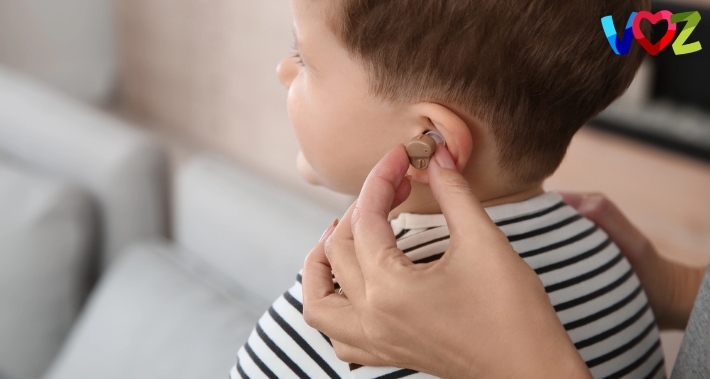
However, if you do choose to fit your child with a hearing aid, we can help.
Children can get their first hearing age as young as 3 or 4 weeks old.
At The Voz Institute, we can help your child learn how to use their hearing aid as a tool to develop their speech and language skills.
2. Deciding On Speech Vs. Sign Language
Another important decision you’ll have to make surrounds the type of communication method you’ll use with your child.
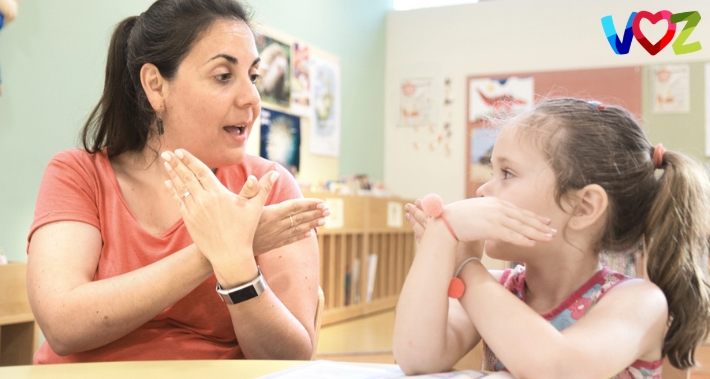
Some hearing impaired children use verbal speech whereas others communicate partially or exclusively in sign language.
Several different factors can influence your decision on this matter.
Examples include:
- Barriers to learning language, such as developmental delays
- Your family’s individual values
- What age your child develops hearing impairment
- Your child’s willingness to use a hearing aid
At The Voz Institute, we can help walk you through your options and make the right choice for your family.
3. Helping Them Develop Speech And Language
Once you decide on the type of communication method you’ll primarily use with your child, we can get to work helping them develop their speech and language skills.
There are many different types of strategies we might use in your child’s therapy.
For instance, auditory verbal therapy techniques focus on utilizing whatever hearing your child has with or without amplification to develop their listening skills.
In contrast, sign language only approaches focuses on teaching sign language to your child as well as all of their caregivers.
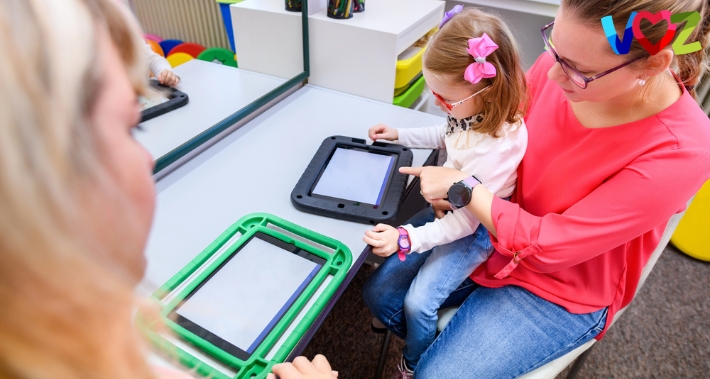
Some families decide on a combination approach, which includes both auditory training as well as augmentative and alternative forms of communication (AAC).
Whatever techniques you decide are right for your child, early intervention is key.
Your child’s brain is most receptive to learning language skills during their first few years of life.
Thus, babies with hearing impairment can begin speech therapy as early as 6 months of age.
Children who develop hearing loss after infancy can begin speech therapy as soon as possible.
RELATED ARTICLE: Who Needs An AAC Device And What Do They Do?
Book Your Appointment With The Voz Institute Today
Navigating hearing impairment in your child can feel overwhelming, especially when you’re faced with important decisions about communication and development.
The good news is that with early guidance and the right support, children with hearing differences can build strong language, social, and communication skills.
Whether your family chooses spoken language, sign language, or a combination approach, speech therapy can help your child develop the tools they need to connect with the world around them.
Early intervention plays a critical role in maximizing your child’s potential during these formative years.
At The Voz Institute, our experienced team is here to guide you through each step and create a plan tailored to your child’s unique needs.
Book your appointment with The Voz Institute today and take the next step in supporting your child’s communication journey.
1100 H St NW Ste 940,
Washington, DC 20005
(202) 734-4884
- https://g.page/vozspeechtherapy
The Voz Institute is a bilingual speech therapy and pediatric occupational therapy clinic in Washington, DC that provides individualized services based on the specific needs of you or your child. Therapy sessions are provided in English or Spanish, depending on your or your child’s native language.
1100 H St NW Ste 940,
Washington, DC 20005
(202) 734-4884
- https://g.page/vozspeechtherapy
El Instituto Voz es una clínica bilingüe de terapia del habla y terapia ocupacional pediátrica en Washington, DC, que ofrece servicios individualizados según las necesidades específicas tuyas o de tu hijo. Las sesiones de terapia se ofrecen en inglés o español, dependiendo del idioma nativo tuyo o de tu hijo.