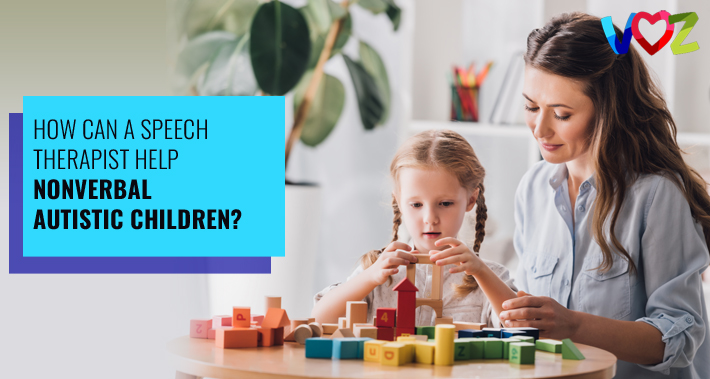
It can feel overwhelming as a parent when you’re trying to help your autistic child develop the communication and social skills they need to thrive.
While tips and strategies can be helpful, sometimes additional support is necessary.
Some autistic children experience significant challenges with spoken language.
Others may not use verbal speech at all.
However, being nonspeaking does not mean a child cannot communicate.
Many autistic children use alternative methods to share their thoughts, needs, and emotions in meaningful ways.
Speech therapy can help identify your child’s strengths, understand their communication differences, and introduce tools and strategies that support more effective interaction.
In this article, we’ll explore what nonverbal autism means, common signs to look for, and how speech therapy can help your autistic child build communication skills in ways that work for them.
What Is Nonverbal Autism?
Autism is a spectrum.
This means that the signs of autism can vary widely from person to person.
This is true with speech symptoms as well.
RELATED ARTICLE: Are Autism And Stuttering Linked?
Some autistic people don’t experience any communication challenges.
In these cases, speech therapy isn’t necessary.
On the other extreme, however, some autistic people can’t speak at all.
This is what we call nonverbal autism.
This isn’t an actual medical diagnosis; however, speech therapists and other professionals use it to specify autistic individuals who can’t speak.
According to 2021 review by Posar and Visconti, 25% to 30% of autistic children are nonverbal or minimally verbal.
It’s important to note that nonverbal autism doesn’t mean that your child can’t communicate at all.
RELATED ARTICLE: Why Do People Still Believe These Autism Myths?
For instance, they may still be able to use words through other methods, like writing.
With new therapies and technology, autistic people who are nonverbal can learn to communicate through other means as well, such as computers and tablets.
Like autism itself, nonverbal autism exists on a spectrum.
Some autistic people who are nonverbal may still be able to use some specific words to relay their needs or wants but can’t carry sustained conversations.
Similarly, some may be able to speak or copy speech but are unable to construct it into meaningful language.
RELATED: Speech Therapy For Expressive & Receptive Language Disorders
Signs Your Child May Be Nonverbally Autistic
Autism is a developmental disorder that causes certain difficulties in social communications and interactions.
There are a wide array of signs and symptoms that may indicate your child is autistic.
Some categories to look out for include social, behavioral, and developmental difficulties and limitations.
But what should you look out for to determine if they are also nonverbal.
One of the main symptoms is not being able to speak clearly and without interruptions.
More specifically, nonverbal autistic kids generally don’t speak at all.
There are several factors that can limit their ability to speak.
This includes things like:
- Speech sound disorders like apraxia of speech
- Developmental delays
- Echolalia
- Selective mutism
Intervention with speech therapy may help your child communicate more effectively, whether verbally or with other methods.
RELATED ARTICLE: How To Recognize Speech or Language Developmental Delays In Children
What Causes Nonverbal Autism?
There are several factors that can contribute to the development of autism.
Things like parental age, prenatal exposure, genetic mutations and disorders, premature birth, and chemical and metabolic imbalances can play a role in the development of autism.
It’s uncertain why some autistic people can’t, or choose not to, use spoken language.
Especially because some nonverbal autistic people can still communicate by using AAC systems, including digital tools, American sign language (ASL), and picture cards.
One common contributing factor for nonverbal autism is childhood apraxia of speech.
This condition is a neurological disorder that can make speaking more difficult.
Most nonverbal autistic people don’t have apraxia of speech, however.
It’s important to note that nonverbal autistic children aren’t necessarily intellectually disabled either.
Underdeveloped verbal communication skill is another potential cause for nonverbal autism.
Finally, echolalia, a condition that causes people to repeat noises and phrases, may also affect meaningful verbal communication.
How Can A Speech Therapist Help With Nonverbal Autism?
If your child is nonverbal and autistic, there are therapies and strategies to help them learn to engage and socialize with others.
Despite any disabilities or limitations, they can still find ways to communicate and gain more independence.
Speech therapy focuses on developing communication and language skills.
If it’s possible, your child’s speech therapist can also try to help build up their speech skills.
Intervening as early as possible can help give your child the best chance for future success.
Let’s take a closer look at how a therapist can help children with nonverbal autism.
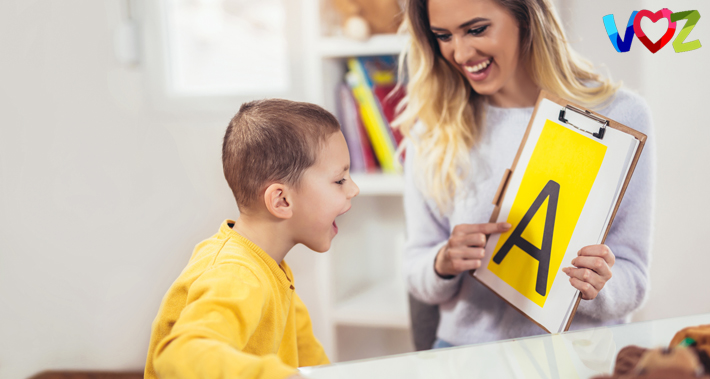
1. Finding Out If They’re Able To Speak
Some autistic kids have delayed speech but eventually develop the ability to use spoken language.
Whereas others never develop their verbal communication skills.
So, how do you tell the difference?
The first step is to evaluate whether your autistic nonverbal child has the potential to use spoken language.
Can they say a few words or make sounds to indicate a need or want?
In this case, implementing different approaches can help them get to a point where they can communicate more effectively.
Your child’s speech therapist can help encourage this.
If speech isn’t a viable option, there are many other alternatives to communicate.
RELATED ARTICLE: What Speech Development Skills Should Your Child Learn At Each Age?
2. Deciding On An ACC Solution
Augmentative and alternative communication, or ACC, refer to any type of tool or aid that helps you communicate without the ability to speak.
According to a 2015 review by Jennifer B Ganz, AAC devices can provide a means for meaningful communication for autistic kids.
There are several options we can use and implement into your child’s therapy.
We can also incorporate modern technology to assist your child in expressing themselves.
Devices like a single button voice output device have one button that reads out a prerecorded message when you push it.
Multi button voice output devices have several buttons to choose from that all have different meanings and messages.
There are also dynamic display voice output devices that present many buttons and options on a touch screen.
Once you push a button, it leads to another series of buttons that allow your child to express more complex ideas.
Some nonverbal children may still have the ability to write or type words and phrases on paper or on a digital device.
Aside from devices, ACC can also include the use of gestures and body language to express ideas and emotions.
Sign language is another option that can allow your child to speak using their hands to form signs.
In this situation, both you and your child can communicate with each other using sign language.
Other options include using objects to represent desires.
This is ideal for children who have cognitive or visual impairments.
You can also use picture boards or picture exchange communication systems (PECS) in which your child uses images to express themselves.
When you’ve discovered what methods work best, the next step is understanding and using them as often as possible to get your child comfortable.
Over time, AAC methods can teach your nonspeaking autistic child new ways to communicate.
3. Teaching Other Skills
Improving your child’s imitation skills can help them get into a habit of associating gestures or body movements with desires.
Reinforce the activities and objects they prefer.
By working imitation skills into daily life, it can allow your child to work on their fine motor skills, communication, and playtime activities.
Another good idea is teaching your child how to take turns and request something.
Using ACC methods, your child can let you know when it’s their turn to do something or have an item.
Withholding that item for a short time can get them to inform you that it’s their turn on their own.
There are many games and activities you can use to reinforce imitation and turn taking skills.
These skills can further help your child develop communication and social skills.
How Can An Occupational Therapist Help With Nonverbal Autism?
A pediatric occupational therapist can also help your child increase their communication and socialization skills.
Occupational therapists work with children to increase their ability to perform daily tasks and responsibilities.
Part of this process includes identifying and providing interventions for any fine motor skill difficulties.
Fine motor skill challenges can create additional barriers for your child when they are trying to navigate the world of AAC.
For instance, they might find it difficult to move their hands in the necessary ways to push buttons or communicate using sign language.
In these cases, an occupational therapist can work on strengthening any limitations that are stopping your child from developing their communication skills.
At The Voz Institute, we can work with your child to understand their specific limitations and create a personalized intervention plan that addresses these challenges.
RELATED ARTICLE: Why Some Kids Struggle With Handwriting And How Occupational Therapy Helps
Book Your Appointment With The Voz Institute Today
If your autistic child is nonspeaking, it’s important to remember that communication is still possible — it may simply look different.
With the right support, children can learn meaningful ways to express their thoughts, needs, and emotions through AAC, gestures, sign language, writing, or emerging verbal skills.
Pediatric speech therapy focuses on identifying your child’s strengths and building a communication system that works for them, while pediatric occupational therapy can address the motor and sensory skills that support successful AAC use.
Early, individualized intervention can make a powerful difference in your child’s confidence and independence.
At The Voz Institute, our team of therapists is committed to helping every child communicate in ways that honor who they are.
Book your appointment with The Voz Institute today and take the next step in supporting your child’s communication journey.
1100 H St NW Ste 940,
Washington, DC 20005
(202) 734-4884
- https://g.page/vozspeechtherapy
The Voz Institute is a bilingual speech therapy and pediatric occupational therapy clinic in Washington, DC that provides individualized services based on the specific needs of you or your child. Therapy sessions are provided in English or Spanish, depending on your or your child’s native language.
1100 H St NW Ste 940,
Washington, DC 20005
(202) 734-4884
- https://g.page/vozspeechtherapy
El Instituto Voz es una clínica bilingüe de terapia del habla y terapia ocupacional pediátrica en Washington, DC, que ofrece servicios individualizados según las necesidades específicas tuyas o de tu hijo. Las sesiones de terapia se ofrecen en inglés o español, dependiendo del idioma nativo tuyo o de tu hijo.