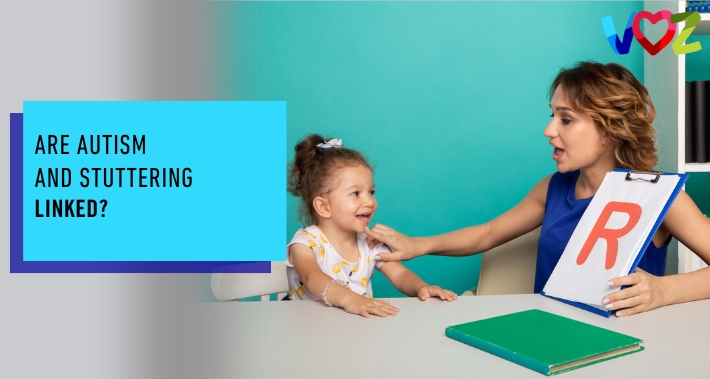
While autism is known for its impacts on communication, behavior, and social skills, its connection to stuttering is less known.
At The Voz Institute, we offer speech therapy for autism and the stuttering that may be concurrent with this diagnosis.
This can support your child to improve their communication and become more independent.
In this article, we’ll take a closer look at autism and stuttering.
We’ll delve into what autism and stuttering are, the connection between these two conditions, and how you and a speech therapist can help your child.
What Is Autism
Autism spectrum disorder, or autism, is a neurodevelopmental disorder.
That means it’s a difference in how the brain develops, and it’s present at birth.
It affects the way a person thinks, feels, behaves, and interacts with the world.
As the “spectrum” in the name would suggest, autism exists on a spectrum.
That means it manifests in several different ways.
As a result, autistic people experience a variety of traits, including difficulty with:
- Making eye contact
- Understanding and expressing emotions
- Expressing needs
- Forming and maintaining relationships
Moreover, autistic people may engage in repetitive movements or speech patterns, known as stimming.
This includes hand flipping, rocking back and forth, and humming.
While these are common signs, your child may also experience speech challenges.
Speech differences in autistic people exist on spectrum as well.
Some autistic kids may have no differences in their speech at all, while others may be unable to speak entirely.
RELATED: How Can AAC Help Autistic Kids Communicate?
In some cases, it includes stuttering.
What Is Stuttering
Stuttering is a fluency disorder.
RELATED: Speech Therapy For Fluency Disorders
That means it affects the flow, rate, and rhythm of your speech.
As a result, your child may experience a pattern of repeating words, sounds, and syllables.
They may have also experience disruptions in the flow of their speech or have uneven speech.
Your child will generally know what they are trying to say, but their flow of speech is interrupted in such a way that getting these thoughts out becomes difficult.
Some sounds may be more difficult to say than others.
If your child stutters, you may also notice the following additional signs:
- Anxiety and frustration related to speaking
- Adding filler words to their sentences, such as “uh”
- Tension within their voice
- A rearranging of words within a sentence
- An elongation of some sounds in words
- Physical symptoms such as tics, lip tremors, or tension in the body
These symptoms of stuttering may also be more pronounced if your child is anxious or in a high-stress setting.
You’re not alone if your child is facing these challenges.
In fact, stuttering is fairly common in young children and usually occurs between the ages of 2 and 6.
For most children the condition resolves without intervention, but this is not always the case.
Some children will continue to experience stuttering into adulthood.
This can lead to challenges in communication and with relationships.
Currently, it’s difficult to tell whether your child’s stuttering will resolve on its own.
That’s why it’s a good idea to seek early intervention from a speech therapist.
When treated at a young enough age, stuttering can be significantly improved, and sometimes resolved altogether.
What’s The Connection Between The Two
It’s estimated that about 1% of the general population stutters.
But a 2023 study by Pirinen Et Al. looked at a group of autistic young adults and found that one in four presented with at least mild stuttering.
That’s a major difference.
Moreover, this study revealed that autistic individuals may significantly revise their speech, pause between words, and abandon words.
The exact reason for this difference in prevalence rate is not yet known.
But there are some theories related to the connection.
One theory related to the connection involves sensory processing challenges.
Since autistic individuals navigate the world differently, they may experience more sensitivity to the sensory inputs from the world around them.
Processing these sensory inputs can be mentally taxing and leave them with not much energy for speaking, which can cause speech issues.
An additional theory is related to the idea that your child may experience more stuttering when stressed or anxious.
For autistic children who experience emotional dysregulation, they may experience stronger emotions and experience a higher rate of stuttering as a result.
Finally, cognition could be another reason.
Autistic individuals generally have a more difficult time with understanding the contents of a conversation and social skills.
Your child may spend more time processing language as a result.
This may take up a large portion of their thoughts.
Again, devoting time to processing one thing can take away from the ability to do another.
So, processing language makes speaking the words more difficult.
This is a starting point, but additional research is needed to understand the link between the two.

What To Do If Your Autistic Child Stutters
If your child is autistic and shows signs of stuttering, they may require a support network to help them through these challenges.
Parents are well positioned to be one of these supports.
Though you may have hesitations related to how you can provide this support effectively.
The Voz Institute is here to support you with some effective strategies you could consider.
For starters, the first step to supporting your child is to develop an environment that is supportive of your child’s needs.
You can do this by practicing patience when your child stutters.
Understand that they’re trying their best.
If you get frustrated, try not to show this directly to your child.
This can cause them to become frustrated about their stutter as well.
In addition, along with patience, actively listening as your child speaks is important.
As you do this, you’re letting your child know their voice matters.
As well, recognize that your child may take longer to process language.
For this reason, you could allow them additional time to articulate what they want to say.
When your autistic child knows they are not going to be interrupted as they speak, it gives them additional time to focus on articulating what they need to say.
But most importantly, seek out a speech therapist.
How Can A Speech Therapist Help Autistic Kids Who Stutter?
If you have an autistic child, a child who stutters, or both, speech therapy can help.
The first step is an evaluation of your child’s communication skills.
This will include conversations with you and their other primary caregivers, as well as observations of your child.
From there, your pediatric speech therapist will work to provide a diagnosis.
In particular, they’ll look to rule out other potential explanations for your child’s traits.
For example, some of the signs of autism are also common in kids who are hard of hearing.
Hearing impairment can affect speech development in children, which is probably not surprising.
Speech therapists can help in both scenarios, but the approach we take is different depending on the diagnosis.
Then, they’ll develop a personalized approach that focuses on your child’s strengths and challenges.
Your speech therapist may teach them how to improve their speech patterns by having them monitor various aspects of their speech.
This includes their rate of breath, breath support, and any tension within their laryngeal muscles.
The goal is to help your child communicate clearly and build their self esteem.
Book Your Appointment With The Voz Institute Today
Is your autistic child experiencing signs of stuttering?
If so, speech therapy can help.
Our team of speech therapists has experience in treating stuttering, autism, and the interplay between the two.
Book your appointment with The Voz Institute today.
1100 H St NW Ste 940,
Washington, DC 20005
(202) 734-4884
- https://g.page/vozspeechtherapy
The Voz Institute is a bilingual speech therapy and pediatric occupational therapy clinic in Washington, DC that provides individualized services based on the specific needs of you or your child. Therapy sessions are provided in English or Spanish, depending on your or your child’s native language.
1100 H St NW Ste 940,
Washington, DC 20005
(202) 734-4884
- https://g.page/vozspeechtherapy
El Instituto Voz es una clínica bilingüe de terapia del habla y terapia ocupacional pediátrica en Washington, DC, que ofrece servicios individualizados según las necesidades específicas tuyas o de tu hijo. Las sesiones de terapia se ofrecen en inglés o español, dependiendo del idioma nativo tuyo o de tu hijo.